.


The Stop Chlamydia! Use Azithromycin Program
Semi-Annual Report

October 1999-March 2000

 
The Stop Chlamydia! Project
 
The Stop Chlamydia! Project is administered by the Northwest Tribal Epidemiology Center (The EpiCenter), a tribally operated epidemiology program located within the Northwest Portland Area Indian Health Board (NPAIHB).  The Stop Chlamydia! Project is coordinated between the Centers for Disease Control and Prevention (CDC), the Indian Health Service (IHS) National Epidemiology Program, and the Northwest Indian tribes of Idaho, Oregon, and Washington.  The project aims to obtain comprehensive information about Chlamydia trachomatis (CT) infection within Northwest American Indian and Alaskan Native (AI/AN) communities.  The Stop Chlamydia! Project Specialist collects surveillance data from participating tribes and provides technical assistance to support their sexually transmitted diseases (STD) prevention efforts.
 

Participation

 
Currently, 13 Indian health care programs located within the Portland Area tribes participate in this project: Chehalis, Colville, Klamath, Lummi, Makah, Nez Perce, Nisqually, Muckleshoot, Puyallup, Skokomish, Umatilla, Spokane, and Yakama.  The Klamath and Skokomish tribes have recently joined the project and will be included in future reports.

Particpating Northwest
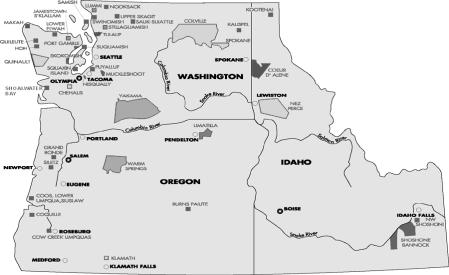
     Tribes
October 1999-March 2000


Participation in the Stop Chlamydia! Project

 
In order for tribes to participate in this screening project, they must submit two completed forms each quarter to the Stop Chlamydia!   Project Specialist.  These forms include: (1) the Chlamydia Surveillance Form (CSF), which is completed by a designated health care worker on each lab confirmed CT case, and (2) the Azithromycin Distribution and Order Form (ADOF), which is completed by the designated pharmacist in order to track the amount of medication prescribed for CT treatment and to order additional Azithromycin.  The CSF is completed for each newly diagnosed case of CT and includes: (1) patient demographics, (2) reason for medical visit, (3) symptoms presented by patient, (4) treatment activities, and (5) follow-up activities.  To compensate the participating tribes for their time and effort, the Stop Chlamydia! Project distributes Azithromycin free of charge for the treatment of CT.
 

Year 2000 Update

 
The Stop Chlamydia! Project received funding from both CDC and IHS to expand testing for CT within Northwest tribal communities during the year 2000.  The Stop Chlamydia! Project's testing efforts will include the use of a less-invasive testing technique known as the Ligase Chain Reaction (LCR) testing method.  LCR received licensure from the Food and Drug Administration in 1995.  LCR effectively detects CT DNA in urine for both females and males.  Research indicates that LCR has a sensitivity of 93-98% and a specificity of 99.9% for diagnosing CT.  Sensitivity indicates the proportion of positives that are correctly identified as positive by the test.  Specificity indicates the proportion of negatives that are correctly identified as negative by the test.  Because LCR is less invasive, patients (in particular male patients) may be more likely to undergo screening for CT infection.
 
The high school that participated in last year's screening project reported that its success prompted them to implement their own project for the year 2000.  In an effort to assist this screening project, the Stop Chlamydia! Project will provide technical support, testing materials, and lab costs.  The objectives for this school-based project are the following: (1) to provide STD prevention information and resource information to high school-aged students, grades 9-12; and (2) to provide students with the opportunity to undergo free and confidential screening for CT.  The School Board, tribal health administration, parents, teachers, and students are enthusiastic and encourage continuation of the screening project.
 

The Stop Chlamydia! Project aims to conduct and support additional screening projects throughout the year.  Future sites will be determined at a later time.

Project Results
The information used for the October 1999-March 2000 Semi-Annual Report was derived from the CSFs.  These forms are completed on a voluntary basis by designated staff at participating Northwest Indian health care programs.  The Semi-Annual Report includes the following:
(1) Number of Reported Cases of Chlamydia by Gender (Figure 1)
(2) Number of Diagnosed Cases of Chlamydia by Age Group (Figure 2)
(3) Reason for Medical Visit by Female Patients (Figure 3)
(4) Asymptomatic versus Symptomatic Reports for Female Patients (Figure 4)
(5) Asymptomatic versus Symptomatic Reports for Male Patients (Figure 5)
(6) Follow-up Activities (Table 1)

(7) The Most Common Types of STDs Diagnosed within Previous Year (Figure 6)
 

Seventy-one CSFs were submitted to the Stop Chlamydia! Project between October 1999 and March 2000 from 11 participating Northwest Indian health care programs.
 

Figure 1. Number of Reported Cases of Chlamydia by Gender.
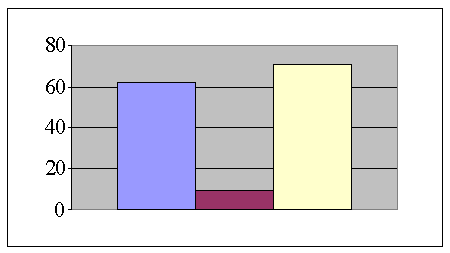
 

Purple: Female N=62
Maroon: Male N=9
Yellow: Total N=71

Females are more easily identified in most CT screening programs because of their access to health care for routine pap exams and family planning.  For CT screening to be successful, men must also be routinely screened and treated.

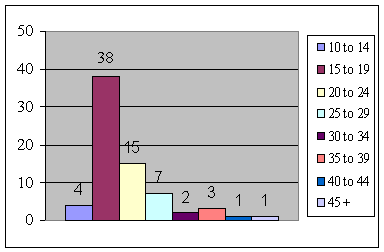
Figure 2. Number of Diagnosed Cases of Chlamydia by Age Group.


Eighty-five percent (85%) of the positive CT cases were in the 15-19 age grooup. This trend is consistent with national rates. N=71

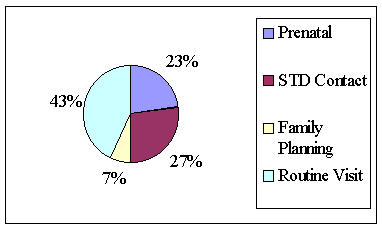
Figure 3. Reason for Medical Visit:  Female Patients.

Nearly half of the female patients were diagnosed with CT during a routine medical visit.  This trend is also consistent with national rates. N= 60


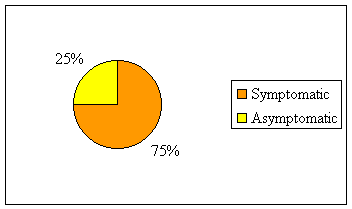
Figure 4. Symptomatic vs. Asymptomatic:  Female Patients.

Seventy-five percent (75%) of the female patients presented medical symptoms at the time of the medical visit.  The most common symptoms for CT reported by women were vaginal discharge (45%, 23/51) followed by pelvic pain (20%, 10/51).  (Note: Eleven respondents did not answer this question.) N=51
 

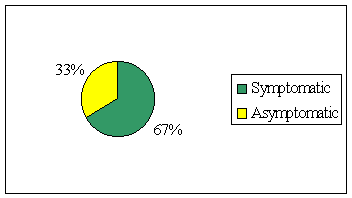
Figure 5. Symptomatic vs. Asymptomatic:  Male Patients.of these

Sixty-seven percent (67%) of male patients diagnosed with CT experienced medical symptoms and sought medical treatment.  Most patients presented symptoms of penile discharge (44%, 4/9). N=9

Table 1.  Follow-Up Activities.

CSF Questions and Outcomes

Total

n =

Total

Yes

% Yes

Were medications given to patients for contacts?
63
18
29%
If female, was the patient positive for Pelvic Inflammatory Disease?
         57
2
4%
Was patient offered counseling and testing for HIV?
60
41
68%
Was the state health department notified?
52
48
92%
Were partners referred for follow-up?
63
18
29%

Figure 6.  Female and Male Patients Diagnosed with an STD within the Previous Year.
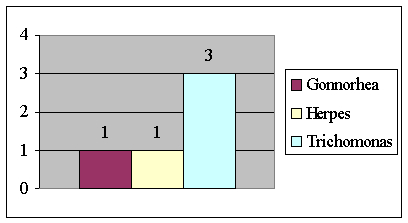
Five (5) patients indicated they had been diagnosed for an STD within the previous year.  The most common STD was Trichomonas (n=3), followed by Gonorrhea (n=1), and Herpes (n=1)  Total n=5

Follow-up Activities

Several questions on the CSFs focused on follow-up activities.  However, these questions are often left unanswered by the staff that submits the forms.  It is unknown whether the data are truly missing, inadvertently not included, or unknown.  The quality of this report is highly dependant on the medical staff who fills out the forms and submits them each quarter.  In order to make the data more complete, on-site reviews will need to be conducted to ensure that proper reporting protocol is followed.
 
STD:
Did the patient have a previous history of STD?
 
Of the 71 forms submitted by Northwest Indian health care programs during
October 1999-March 2000, only four forms included answers for the question regarding a previous history of an STD.
 
Pelvic Inflammatory Disease (PID):
If female, was the patient positive for (PID)?
Of the 62 females diagnosed with CT during October 1999-March 2000, 57 forms included answers for the question regarding positive PID.  Of these, two forms (4%, 2/57) indicated a positive result.

HIV counseling and testing:
Was patient offered counseling and testing for HIV?
Of the 71 forms submitted by Northwest Indian health care programs during October 1999-March 2000, 60 forms included answers for the question regarding HIV counseling and testing.Of these, 41 (68%) forms indicated that patients with CT received HIV counseling and testing.
State Health Department:
Was the state health department notified?
Of the 71 forms submitted by Northwest Indian health care programs between October 1999-March 2000, 52 forms included answers for the question regarding reporting of CT to the respective State Health Department.Of these, 48 (92%) forms indicated that new cases of CT were reported to the state health departments of Idaho, Oregon, and Washington.

Contact Referral:

Were sexual partners referred for follow-up?

Of the 71 forms submitted by Northwest Indian health care programs during October 1999-March 2000, 63 forms included answers for the question regarding medication distribution for sexual partners.  Of these, 18 (29%) forms indicated that patients with CT were given medication for their sexual partner(s).

 
A majority (87%, 62/71) of positive CT cases were reported for women compared to men (13%, 9/71).  Eighty-five percent (85%) of all reported cases (male and female patients combined) were between the ages of 15-29 years.  These data are consistent with national CT rates.
 
Female Patients
 
Fifty-one CSFs indicated whether female patients were either symptomatic or asymptomatic at the time of diagnosis.  During the last six months of reporting, 75% (38/51) of the female patients indicated symptoms, whereas 25% (13/51) were asymptomatic at the time of diagnosis.  Forty-five percent (45%, 23/51) of the symptomatic female patients presented vaginal discharge at the time of the medical visit, whereas 20% (10/51) reported pelvic pain.  Please note, 11 forms submitted left this answer blank, so were not included in this question.
 
Of the female patients diagnosed with CT, almost half (43%, 26/60) of the diagnoses occurred during a routine medical visit; 23% (14/60) of the patients were diagnosed during a prenatal visit; 27% (16/60) had sexual contact with an individual who had tested positive for an STD and therefore sought screening for STDs; and 7% (4/60) were diagnosed during a family planning visit.

Male Patients
Of the male patients diagnosed with CT, over half (67%, 6/9) reported medical symptoms and, thereby, sought medical treatment.  One-third (33%, 3/9) of the male patients were asymptomatic at the time of screening.  Of those patients with symptoms, penile discharge was most prevalent (44%, 4/9) at the time of detection.

Discussion

Seventy-one new cases of CT were reported to the Stop Chlamydia! Project between
October 1999 and March 2000 from the 11 participating Northwest Indian health care programs.
 
Of the 71 diagnosed cases, CT was most common among female patients between the ages of 15 and 29 years who were screened during a routine medical visit.  Substantially fewer male patients were screened and diagnosed with CT at Northwest Indian health care programs for the semi-annual reporting period from October 1999 to March 2000.  Of the males diagnosed, penile discharge was the symptom that prompted them to seek medical services and treatment.
 
According to published data, approximately 75% of females and 50% of males who were infected with CT were asymptomatic, and the majority of CT cases reported nationally were diagnosed during a routine medical visit.  Low rates of CT among men suggest that many of the partners of women with CT remain infected and untreated for CT.  Until more males get screened and treated for CT, the cycle of re-infection will continue.
 
Conclusion
 
In summary, CT exists among AI/AN youth of our Northwest tribal communities.  If CT is left untreated significant health complications may result, including ectopic pregnancy, infertility, and PID.  However once detected, CT is easily treated and cured with a single dose of Azithromycin.  Obtaining information on topics including, (1) the magnitude of CT infection, (2) various risk behaviors, and (3) follow-up and treatment plans within Northwest AI/AN communities, continues to be an important first step towards development of effective STD prevention programs and for improving the overall health of Northwest Indian communities.

The availability and accessibility of STD screening remains a priority for Northwest Indian health care programs.  Identifying CT infection among individuals who do not demonstrate any signs or symptoms will greatly minimize the potential long-term health complications resulting from untreated CT.

For More Information
If you would like additional information regarding the Stop Chlamydia!  Project please contact:
Shawn L. Jackson
Stop Chlamydia! Project Specialist
Northwest Tribal Epidemiology Center
Northwest Portland Area Indian Health Board
527 SW Hall Street, Suite 300
Portland, OR  97201
Phone# (503) 228-4185, Extension 288
FAX     (503) 228-8182
E-mail: Sjackson@npaihb.org

"I would like to give a special thanks to Kelly Gonzales and Francine Romero for their contribution in the development of this report."

Last Updated: September 14, 2006


Our mission: To assist Northwest tribes to improve the health status and quality of life of member tribes and Indian people in their delivery of culturally appropriate and holistic health care.